
Connections
Connections
A connection (also called a data source) is a saved pointer to one PostgreSQL database that queries run against. It holds the connection details plus per-connection safety limits, and shows the database's live health.
Connections are managed by administrators. You need the Manage data sources capability to add or edit them.
When to use
An administrator adds a connection before anyone in the organization can write or run queries against that database. You edit a connection to change its credentials or limits, and refresh its cached schema when the database structure changes.
Add a connection
- Go to Admin → Connections and choose New connection.
- Fill in the connection details:
- Name and an optional Colour to tell connections apart at a glance.
- Hostname, Port (default
5432), Database, and Default schema (defaultpublic, where the schema browser and autocomplete start). - Username and Password.
- SSL mode, one of
disable,prefer,require,verify-ca, orverify-full. - Statement timeout (default
30000ms), Row limit (default1000rows), and Result size (default10MB). These caps protect the database and keep result sets manageable. - Enable query advisor, on by default. It shows query-quality hints.
- Click Test connection to check the settings. On success you see a summary
such as
Connected · PostgreSQL 14 · user@db. On failure you see the API's error, and the form marks the offending field where possible. - Click Save.
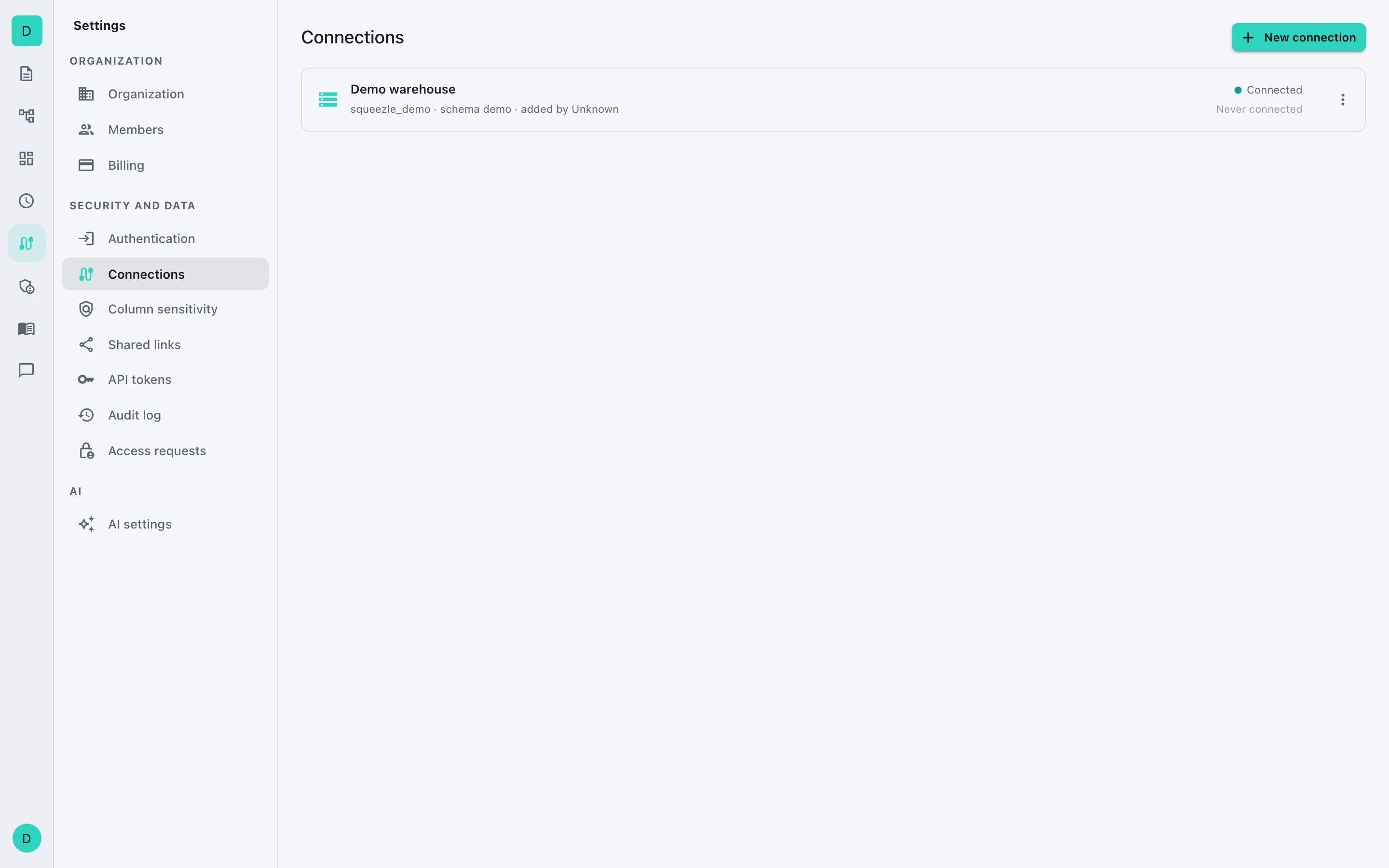
Connection health
A connection's status updates live and is one of:
- Connected. The pool is open and serving queries.
- Ready. No pool is open yet; one starts on the first query. This is the normal resting state, not a fault.
- Error. The last connection attempt failed; the row shows the error.
- Disabled. Switched off; no queries will run against it.
To rebuild a connection's cached schema (after tables or columns change), open the row's ⋮ menu and choose Refresh schema.